The Ethos of Dematerialization (1978)
Luceplan was founded in Milan in 1978 by three close collaborators: architect Paolo Rizzatto, engineer Riccardo Sarfatti (son of legendary lighting pioneer Gino Sarfatti), and celebrated industrial engineer Alberto Meda. Unlike manufacturers who emphasized mass and heavy marble, Luceplan adopted a design philosophy anchored in dematerialization: doing more with less raw material, engineering for flat-pack distribution, and ensuring components can be separated and recycled at life's end.
Alberto Meda, renowned for his mastery of advanced polymer composites, brought an engineer's economy of means to the lighting discipline. A prime example is the Costanza (1986). Designed by Paolo Rizzatto, it re-invented the traditional lampshade using a lightweight, washable, screen-printed polycarbonate sheet fastened to an aluminum tripod by only two pins. If bumped, the shade flexes rather than snapping; if shipped, hundreds of shades nest together flat in a single carton.
The Fresnel Revolution: Hope (2009)
In 2009, Francisco Gomez Paz and Paolo Rizzatto designed the Hope chandelier. Rather than using lead crystal prisms that weigh tens of kilograms and demand reinforced ceiling joists, Luceplan manufactured ultra-thin, laser-cut polycarbonate Fresnel lenses.
These micro-grooved lenses duplicate the optical refraction of heavy crystal chandeliers at a fraction of the physical weight. When disassembled, the entire six-foot chandelier packs into a compact cardboard box. Suspended from the ceiling, its refractive facets split light into thousands of sparkling highlights without burdening the structural framing.
The Dual Challenge: Uniting Optics with Acoustics
As modern offices, lofts, and restaurants shifted toward exposed concrete ceilings, polished terrazzo floors, and expansive glass curtain walls, architects faced an acoustic crisis: excessive reverberation times that caused speech fatigue.
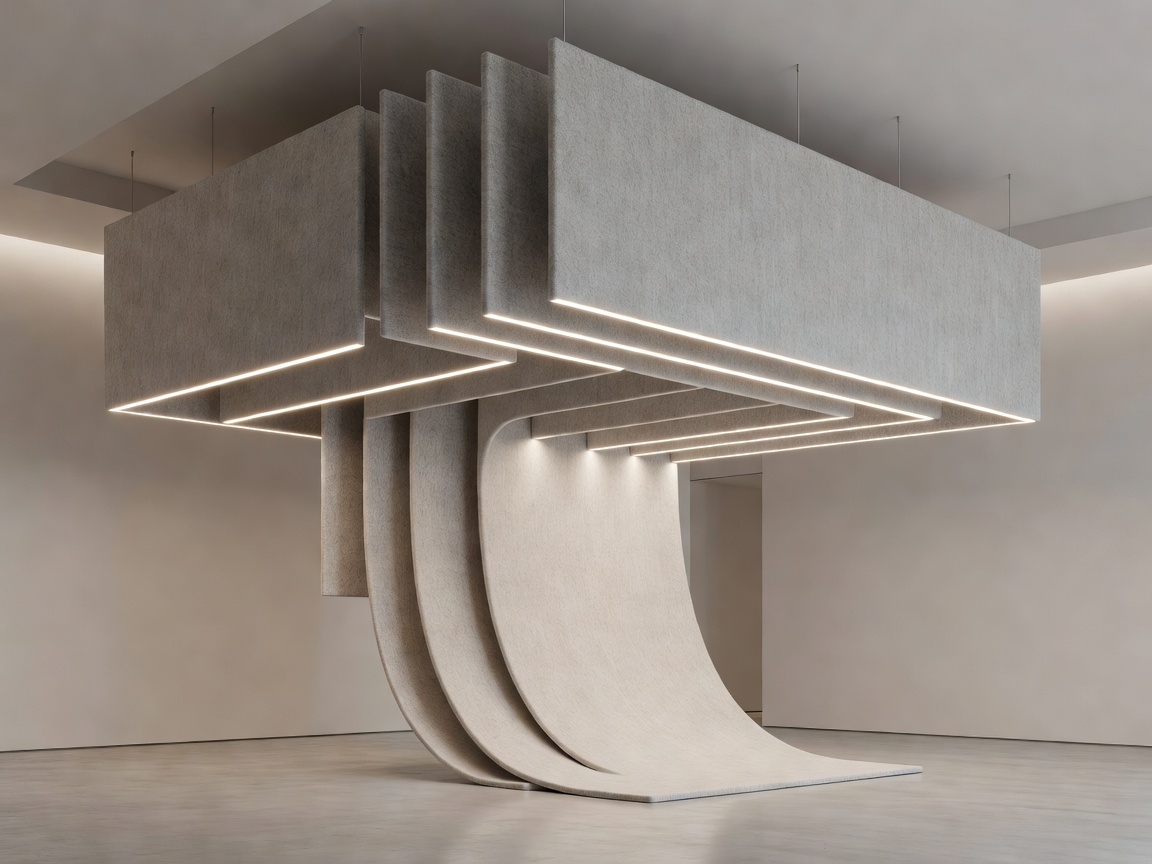
Luceplan recognized that the ceiling plane offers the largest unobstructed real estate for sound absorption. Partnering with designers like Monica Armani, Luceplan launched its pioneering collection of Acoustic Light. Luminaires like the Silenzio and Pétale incorporate:
- Sound-Absorptive Cores: Specially density-graded polyurethane foam and recycled textile battings that trap acoustic waves between 250 Hz and 4000 Hz.
- Textile Finishes: Upholstery in premium Kvadrat wool fabrics that allow sound waves to enter the core without acoustic reflection.
- Isolated LED Engines: Thermally decoupled LED heat sinks that exhaust heat outside the acoustic cavity, safeguarding electronic lifespans.
Technical Assessment: Luceplan Architectural Highlights
| Model | Designer | Material Core | Key Technical Innovation | Architectural Application |
|---|---|---|---|---|
| Costanza | Paolo Rizzatto | Aluminum, Screen-printed Polycarbonate | Sensorial dimmer rod switch; interchangeable shade | Hospitality bedside, residential lounge |
| Hope | Gomez Paz & Rizzatto | Stamped Polycarbonate Fresnel Lenses | Micro-optic refraction with near-zero deadweight | Double-height atriums, ballroom accents |
| Silenzio | Monica Armani | Acoustic Foam, Kvadrat Wool, Metal Chassis | Reverberation reduction paired with downward LED | Boardrooms, restaurants, open-plan offices |
| Compàs | Studio Natural | Die-cast aluminum, high-grade silicones | Configurable geometry with tool-free adjustments | Architectural linear perimeter and wall washing |
Specification Evaluation: Merits & Considerations
Engineering Merits
- Acoustic Multi-Tasking: Eliminates the need for redundant acoustic ceiling rafts by integrating sound absorption into lighting.
- Low Shipping Footprint: Clever demountable engineering minimizes freight emissions and site delivery damage.
- Replaceable Components: Modular shades, drivers, and circuit boards can be swapped on-site without discarding the fixture.
Specification Considerations
- Fabric Maintenance: Acoustic textile surfaces in dining environments require periodic vacuuming or dry-cleaning.
- Spatial Clearance: Large acoustic pendants (up to 1.5 meters diameter) require generous architectural ceiling heights.
Conclusion: The Architecture of Responsible Light
Luceplan’s evolution represents the ultimate maturity of Italian design culture. By merging rigorous polytechnic engineering with the acute spatial challenges of modern open architecture, Luceplan proves that high design is not an indulgence of form, but an intelligent, sound-absorbing, and material-conscious stewardship of human spaces.