The Conceptual Breakthrough: Light as Architectural Structure
In 1962, when Dino Gavina and Cesare Cassina backed the design experiments of brothers Achille and Pier Giacomo Castiglioni, European domestic lighting was dominated by ornate chandeliers and static textile shades. Flos rejected these decorative assumptions immediately. The Castiglioni studio approached lighting as an exercise in structural problem-solving, employing principles borrowed from civil infrastructure, street lamps, and automotive headlights.
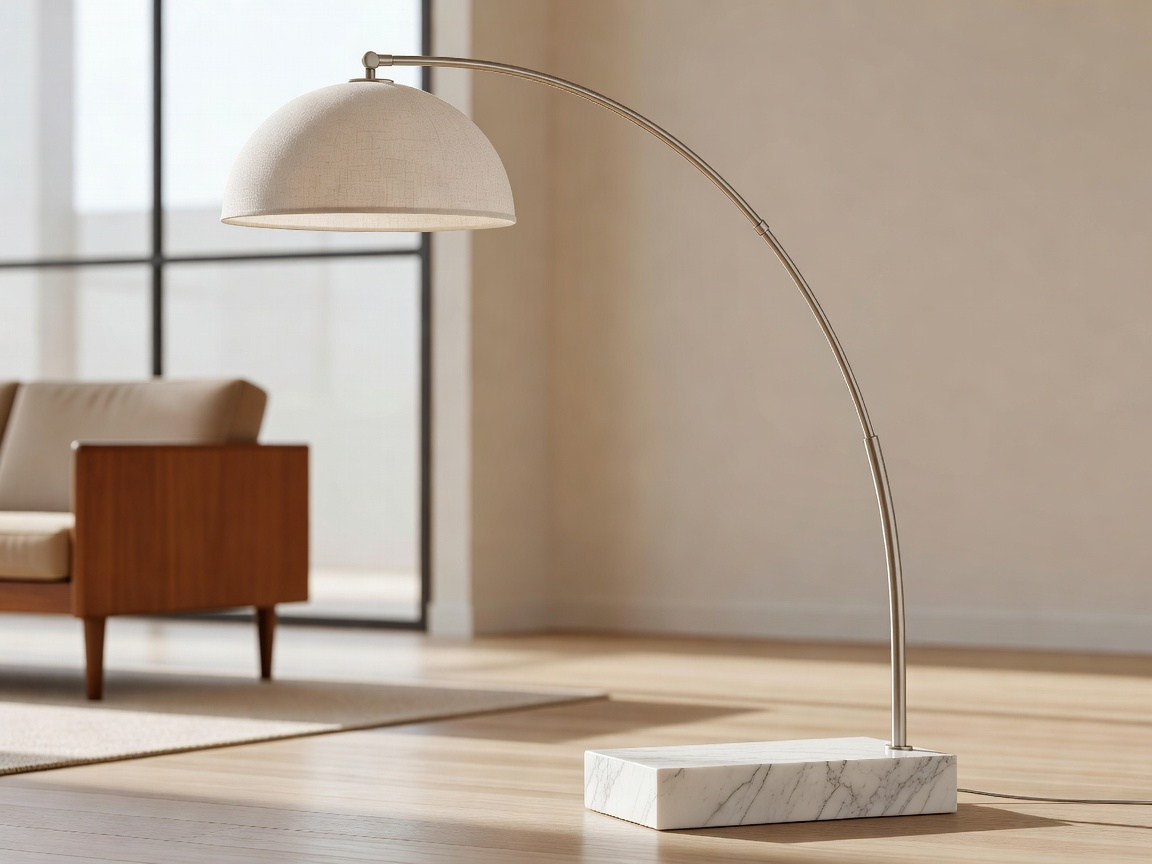
The crowning manifestation of this ethos was the Arco (1962). The brothers recognized a persistent dilemma in historic European apartments: high ornamental plaster ceilings where dining tables rarely aligned with central junction boxes. Their solution was an overhead lamp that stood firmly on the floor. Rather than relying on a fixed ceiling pendant, a solid Carrera marble base served as a 65 kg counterbalance for an articulated stainless-steel channel that could project light over two meters away.
Crucially, the Castiglionis avoided gratuitous styling. The hole bored through the marble base was not decorative; it was calibrated to accommodate a broom handle so two people could lift and reposition the massive block. The bevels on the marble corners were cut specifically to eliminate sharp 90-degree edges that chipped during transit. This ruthless functional rigor remains the bedrock of Flos’s identity.
Material Exploration: The Cocoon Series and Polymer Skin
Before the debut of their metal floor luminaires, Flos pioneered the use of "Cocoon" — a synthetic liquid polymer resin initially synthesized by the United States military for mothballing surplus naval vessels. Working with Tobia Scarpa and the Castiglionis, Flos sprayed this fibrous polymer onto complex welded steel wire armatures.
The resulting fixtures, including the Taraxacum and Viscontea, cast an eerie, diffuse, membrane-filtered glow reminiscent of silk lanterns yet possessing mechanical resilience. This technique proved that industrial materials could achieve sensual organic warmth without descending into retro-decorative mimicry.
Specification Matrix: Landmark Flos Architectural Works
| Model | Year | Lead Designer | Materiality | Primary Luminous Function |
|---|---|---|---|---|
| Arco | 1962 | A. & P.G. Castiglioni | White Carrara Marble, Extruded Steel, Spun Aluminum | Cantilevered Overhead Task / Dining |
| Toio | 1962 | A. & P.G. Castiglioni | Automobile Reflector, Fishing Rod Guides, Transformer | Indirect Ceiling Uplight (300W baseline) |
| Taccia | 1962 | A. & P.G. Castiglioni | Fluted Aluminum Base, Hand-Blown Glass Bowl | Diffused Reflected Indirect Ambient |
| Parentesi | 1971 | Castiglioni & Manzù | Tensioned Steel Cable, Shaped Nickel-Plated Tube | 360-Degree Vertical Sliding Directional |
Evaluating the Flos Portfolio: Strengths & Limitations
Architectural Strengths
- Generational Longevity: Genuine parts, cast switches, and blown glass components remain serviceable for decades.
- Kinetic Ingenuity: Fixtures like Parentesi permit infinite height and rotational adjustment via friction alone.
- High Resale Value: Certified original models retain museum and auction prestige indefinitely.
Architectural Considerations
- Weight & Floor Load: The Arco and Taccia require substantial physical footprints and structural floor support.
- Thermal Dissipation: Legacy halogen-to-LED conversions must use precisely matched retrofit elements to maintain optic curves.
- Cost Threshold: High manufacturing overhead makes Flos investments significant for expansive residential schemes.
Contemporary Evolution: Architectural Integration
In modern decades, Flos has expanded from freestanding objects into recessed architectural tracks, acquiring Spanish architectural optics firm Antares to develop sub-millimeter linear systems. Luminaires such as the Running Magnet integrate magnetic modular micro-spots into drywall profiles, translating the Castiglioni spirit of radical subtraction into commercial ceilings, minimalist galleries, and high-spec corporate headquarters across Milan and beyond.