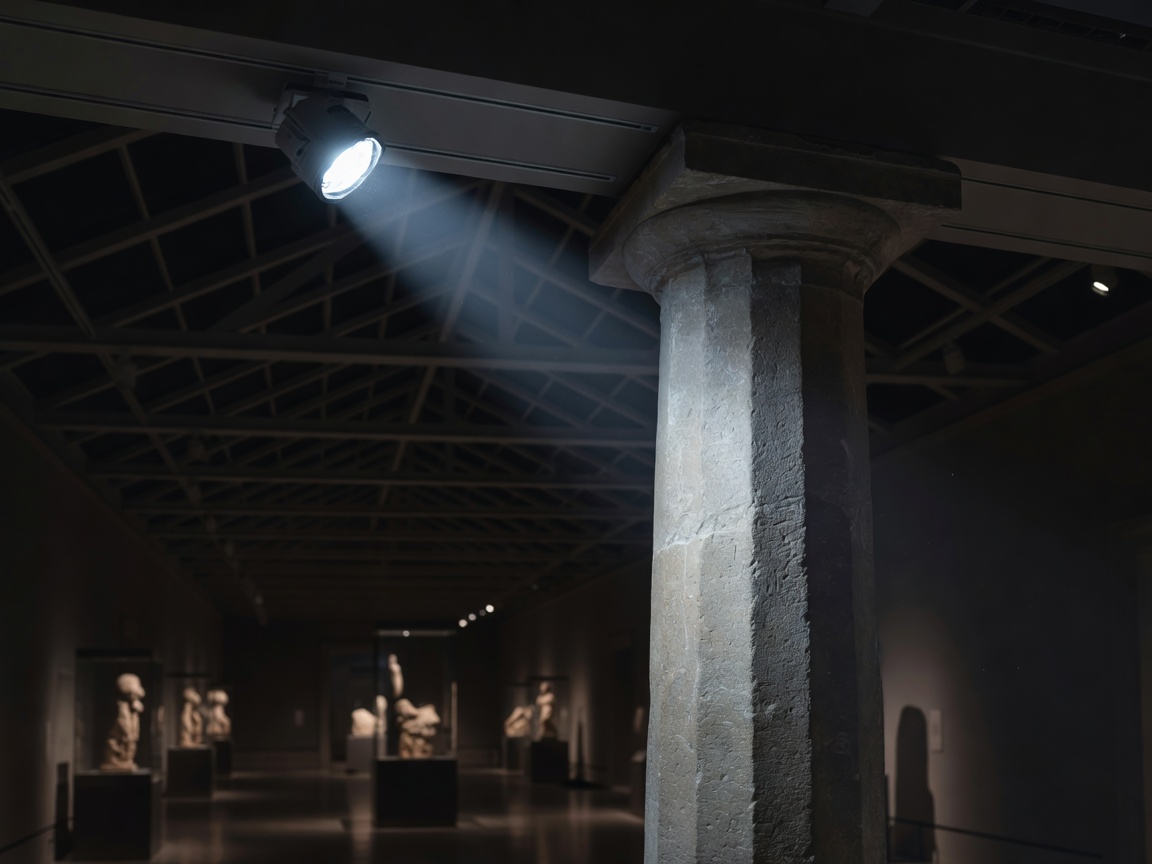
The Shift from Domestic Furniture to Architectural Infrastructure
While Milan was celebrated for the domestic table lamps of the 1960s, a distinct technological movement took root in the Marche region. In Recanati, the Guzzini family shifted from decorative household fixtures to high-performance architectural systems, founding iGuzzini illuminazione.
Recognizing that modern architecture was moving toward dematerialized glass curtain walls and vast cultural centers, iGuzzini invested heavily in optical research, thermodynamic simulation, and precision lighting engineering. Instead of asking what a fixture looks like, their fundamental engineering query became: How can we render the luminaire invisible while sculpting the space with pristine light?
The Breakthrough of "Dark Light" and Visual Comfort
One of iGuzzini’s defining contributions to architectural lighting was the perfection of "Dark Light" parabolic optics. In standard lighting installations, glancing toward the ceiling reveals harsh, bright glare points that fatigue human eyes. Dark Light technology employs computer-calculated dual-parabolic aluminum reflectors that channel light downward in a defined cone (typically 30° to 60° cut-off angles).
Unless an observer stands directly underneath the luminaire looking vertically into the chamber, the ceiling fixture appears completely turned off. This breakthrough permitted high luminous flux across corporate trading floors, university lecture halls, and art museums without compromising human visual comfort (achieving Unified Glare Ratings below UGR 10).
Optical Miniaturization: The Laser Blade Revolution
With the emergence of solid-state LED emitters, iGuzzini engineered the Laser Blade. Rather than relying on traditional bulky circular cans that require 150mm ceiling voids, the Laser Blade integrated micro-optics into linear slots as narrow as 28 millimeters.
By utilizing specialized compound parabolic concentrators (CPC), each micro-cell achieves high luminous efficacy, extraordinary beam uniformity, and zero spill light. This technology allowed architects like Renzo Piano and Jean Nouvel to introduce high-output task illumination into historical frescoes and monolithic concrete slabs without unsightly visual clutter.
Photometric Performance Parameters
| System Line | Optical Architecture | Color Rendering (CRI) | Cut-Off Angle | Primary Architecture Venue |
|---|---|---|---|---|
| Laser Blade | Compound Parabolic Micro-Reflector | Ra > 95 (R9 > 80) | 45° / 55° Dark Light | Corporate Executive, Galleries, Minimalist Suites |
| Palco | Interchangeable Opti Beam Lenses | Ra > 97 / TM-30 Rf 95 | 8° Spot to 56° Wide Flood | International Art Museums & Sculptural Exhibitions |
| Trick | Toroidal 360-degree Micro-Blade Lens | Ra > 80 / 90 | 360° Grazing Skimmer | Facade Framing, Historical Porticos, Arch Ribs |
| Linealuce | Grazing Asymmetric Wall-Wash | Ra > 85 | Asymmetric Longitudinal | Civic Monuments, Bridges, Stone Masonry Wash |
Architectural Systems Analysis
Technical Advantages
- Optical Precision: Unrivaled edge-to-edge beam sharpness without chromatic aberration or secondary rings.
- Conservation Grade: Zero UV and negligible IR radiation protects centuries-old oil paintings and delicate parchments.
- Integrated Protocols: Native support for DALI-2, Casambi BLE wireless, and 0-10V control backbones.
Specification Constraints
- Installation Rigor: Requires tight structural coordination during rough-in to maintain clean flush ceiling interfaces.
- Commissioning Expertise: Museum-grade aiming and lens swapping require trained architectural lighting technicians.
Civic Lighting and Monumental Illuminations
iGuzzini’s systems illuminate global cultural landmarks, including the Scrovegni Chapel in Padua, Paris's Musée d'Orsay, and the historic Roman Forum. In these spaces, light must perform a delicate balance: revealing texture, brushwork, and relief carving with surgical accuracy while preserving fragile substrates for generations to come.