The Aerospace Mindset: Ernesto Gismondi’s Foundation
Founded in Pregnana Milanese in 1960, Artemide emerged from an intersection that rarely existed outside Northern Italy: high-level aeronautical engineering married to progressive architectural theory. Ernesto Gismondi, an aeronautical engineer trained at the Politecnico di Milano, viewed light fixtures not as decorative table pieces, but as precision instruments for biological human support.
This conviction solidified into Artemide’s celebrated design ethos: The Human Light. Under this philosophy, illumination must adapt dynamically to human psychological needs, circadian rhythms, and tactile workspace interactions, rather than demanding humans adjust their posture to a static light source.
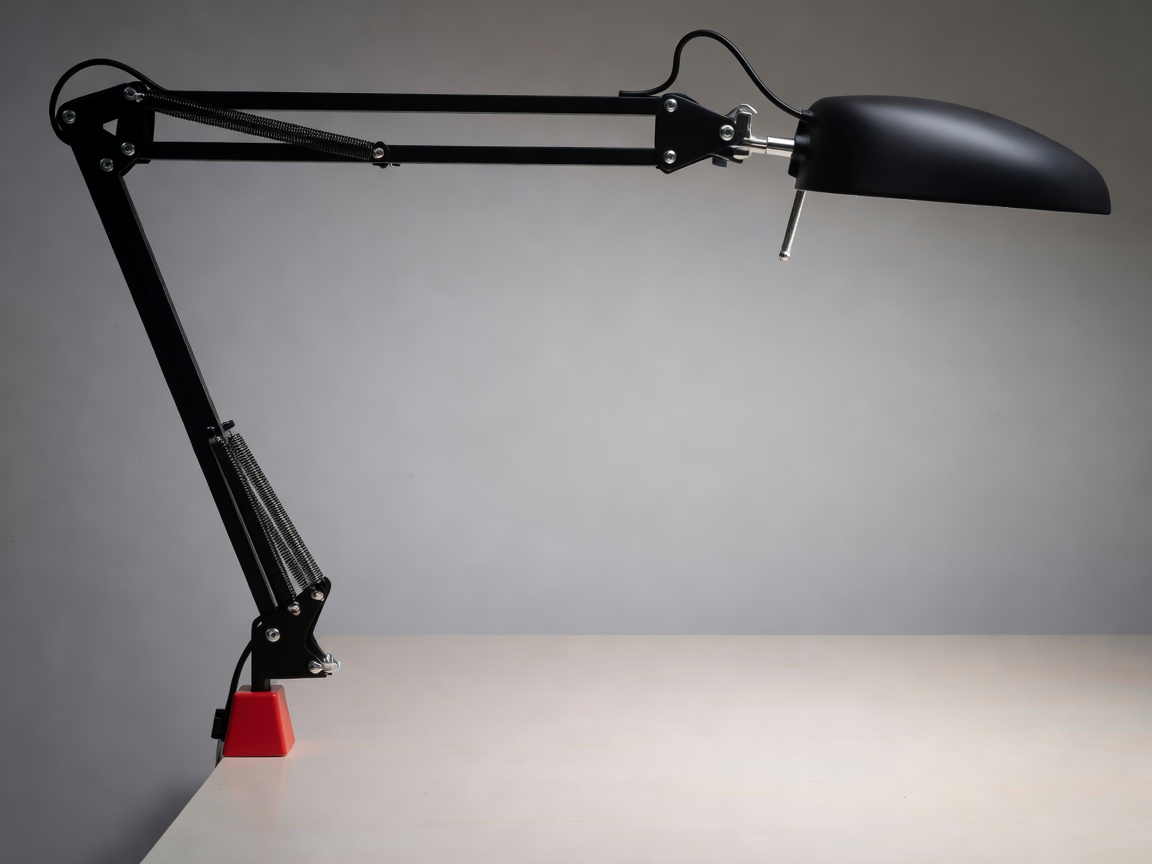
The Engineering Feat of Richard Sapper’s Tizio (1972)
In the early 1970s, industrial designer Richard Sapper approached Gismondi with a radical proposal: a desk lamp with infinite kinetic balance that cast a concentrated beam on drafting tables without cooking the designer’s forehead with excessive radiant heat.
The resulting Tizio represented a double technical breakthrough:
- Cordless Current Conduction: A transformer housed in the heavy cylindrical base stepped 220V mains electricity down to 12V. Because 12 volts posed zero shock hazard to human hands, Sapper passed the current directly through the exposed aluminum structural arms and snap-fasteners, completely eliminating internal or external wiring.
- Kinetic Counterweights: Sapper used zinc counterweights with red accents to balance the articulated parallelogram mechanism, allowing effortless one-finger positioning that held firm in any spatial orientation.
The Ubiquitous Benchmark: Tolomeo by De Lucchi & Fassina (1987)
While the Tizio was a high-tech masterpiece of the 1970s, Michele De Lucchi and Giancarlo Fassina created the most universally adopted desk luminaire of modern history with the Tolomeo in 1987. Inspired by trabucchi—the historic wooden fishing cranes along the Italian Adriatic coast—the Tolomeo utilized a concealed internal stainless-steel cable tension system running over polished aluminum pulleys.
The Tolomeo combined mechanical efficiency with tactile warmth: its spun aluminum head featured a small slot on top, venting bulb heat upward while casting a subtle decorative accent onto the ceiling.
Technical Specifications: Tizio vs. Tolomeo Comparison
| Metric / Feature | Artemide Tizio (1972) | Artemide Tolomeo (1987) |
|---|---|---|
| Balancing Mechanism | Counterbalanced counterweights | Spring-tensioned stainless steel wire pulley |
| Electrical Conduction | Low-voltage structural arm conduction | Internal insulated cable through arm tubing |
| Head Motion | Pivoting head with red nylon joint | 360-degree rotation with stay-cool wire handle |
| Standard Finish | Matte Black, White, Metallic Silver | Anodized Polished / Matte Aluminum |
| Typical Color Temp (LED) | 3000K Warm White (High CRI) | 2700K / 3000K or Tunable White |
Performance Evaluation: Strengths & Project Considerations
Ergonomic Strengths
- Intuitive Tactility: Instant single-handed repositioning without tightening thumb screws or knobs.
- Optical Directionality: Narrow, glare-shielded task beams minimize visual fatigue during prolonged digital drafting.
- Comprehensive Ecosystem: Tolomeo variants extend from micro table clamps to 2.5-meter giant outdoor patio suspensions.
Project Considerations
- Cable Wear Over Decades: High-cycle commercial environments may require cable tension restringing after extensive usage.
- Base Mass Clearance: Both models require clear desk clearance or dedicated clamp/wall grommet installation.
Circadian Photobiology and the Modern Architectural Shift
Today, Artemide continues its scientific exploration through tunable white and multispectral LED systems. In projects for corporate campuses and medical facilities, Artemide luminaires simulate the continuous optical shifts of natural daylight, confirming Gismondi’s founding hypothesis: illumination is not an accessory to architecture, but the biological pulse of the interior space.